


Part 1: Animals of Water, Animals of Land
Now the Lord had prepared a great fish to swallow up Jonah. And Jonah was in the belly of the fish three days and three nights.
-Jonah 1:17 KJV
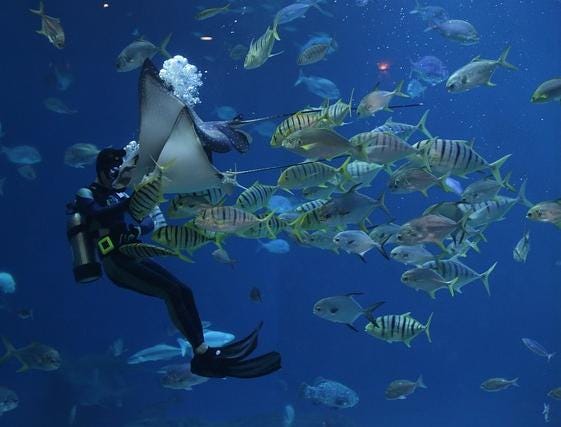
Hey guys – check it out! I found all these cool creatures in the water! There’s a seahorse and starfish and a shark and whole bunch of others. I wonder what kind of creatures they are? If they all live in the water, then they’re probably all fish, right? Well, maybe not, I guess there are some things in the ocean that aren’t fish.
I know this salmon is a fish, though; I mean, I eat them all the time. And look, it has bones including a spine (making it a vertebrate), a tail, scales (like thick plates of skin that cover the body), gills (those slits on the sides of its head for breathing in the water), and several fins to help it swim. Oh, and it’s cold-blooded (its body temperature is the same as the water around it). A couple of the other creatures look the same, like that bluegill and that clown fish, so those have to be real fish, too.
This great white shark looks pretty promising – it has a tail, gills, and fins, too. That seems pretty fish-like, doesn’t it? But this guy doesn’t have any bones…weird. Its skeleton is made of cartilage (the same stuff as your nose and ears), which makes them super maneuverable in the water. And, wait, is this shark warm?! Yes, a few sharks are somewhat warm-blooded (they have some control over their body temperature), making them even more fierce predators. Even though they have some differences from the salmon, they are still fish. Same goes for that hagfish (Why does it look like a headless snake, anyway?) and that stingray; all of them have skeletons made of cartilage, but they are still fish.
Now, this seahorse over here definitely doesn’t look like a fish. Sure it has bones and gills and even a couple of tiny fins, but look at that cute little curly tail. No way that’s a fish. Oh, it is? Fish don’t have to look “fish-shaped,” I guess. So, this engineer goby and this electric eel (don’t get too close!) are fish, too, even though they both look more like snakes than your pet goldfish.
So, then the starfish is totally a fish – it’s right there in the name. They don’t look like fish, but as we just saw, that doesn’t necessarily mean much. Course they don’t have bones or tails or gills or scales or fins…..okay, so maybe they’re not fish. They must be invertebrates, along with this jellyfish, crayfish, and cuttlefish. Man, it’s a good thing some scientists are starting to call these creatures sea stars and sea jellies to keep us from getting confused!
Ok, we’re getting close to figuring all these creatures out, we just have a couple more. These tadpoles definitely looks fish-like. They have bones, gills, and a tail to help it swim through the water. They don’t have fins or scales, though...huh. Hey wait - that one has legs! Oh, right, tadpoles turn into frogs (or toads) because they’re amphibians, along with that cutie pie axolotl [ax-oh-lot-ul] with its fluffy external gills and that kind of creepy caecillian [si-sill-ian] (I mean, it looks like a cross between a snake and a worm and lives underground or in water). These guys start out like looking like a fish and living in the water and then live on land and breathe air as an adult. Their skin, being scale-free, is really cool, though, since the frog can breathe through it as an adult when they swim in water. This superpower comes at a price (they always do), and most amphibians have to keep their skin wet all the time. It’s a good thing we have the Kingdoms of Creation to keep all these amazing and diverse creatures in order.
Check out Chapter 7A Podcast Episode!
Part 2: The Cutthroat and the Hellbender
[Toad asked,] “What did you write in the letter?”
Frog said, “I wrote ‘Dear Toad, I am glad that you are my best friend.
Your best friend, Frog.’”
“Oh,” said Toad, “that makes a very good letter.”
-Arnold Lobel, Frog and Toad are Friends
Every creature has a home made just for it by the Creator, both in the real world and the Kingdoms of Creation. They are perfectly made for that beach or this mountain or that rainforest, with features that allow them to find food and avoid hunters well. This balance of the right creature in the right home can be disturbed by people, however. We don’t always mean to, but sometimes we introduce a new creature or add something to the air or water, or hunt too many of an animal, and, all of a sudden, the creatures have a really difficult time coping. Suddenly there are too many hunters or not enough food or they can’t find places to live. Sometimes, creatures even go extinct, forever lost to us in this world; then the damage can never be fully repaired.
Fortunately, though, the Creator has given us humans the compassion to care about our fellow creatures and the intelligence to fix the problem. This is a story about the tenacity and ingenuity of people to help two such creatures – the Yellowstone cutthroat trout and the hellbender – to restore the balance of the Creator before it is too late.
In Yellowstone National Park in Wyoming, USA, there is a lake (Yellowstone Lake, in fact). It is very large and very deep, home to many creatures, most notably the Yellowstone cutthroat trout, named for the red spots on its throat (not because it is likely to fly through the air and attack you). These medium sized fish live near the surface and go into streams to lay their eggs, making them excellent food for larger animals in the park, such as bears, otters, and eagles. In fact, this fish is a keystone species; losing them means that many other creatures are lost as well.
About 40 years ago, things took a turn for the worse for this fish, when the gigantic, voracious lake trout entered Yellowstone Lake from a nearby lake. Lake trout are native to the Great Lakes and other large lakes further north, but people really like to fish for them, so they brought them to Wyoming. Soon, the lake trout were outcompeting all the native fish species, eating their food (and them) like there was no tomorrow. People made a big mistake by introducing this invasive species, and now all the local fish species were paying for it.
Once the lake trout entered Yellowstone Lake, they ate tons of Yellowstone cutthroat trout, avoided being eaten themselves by staying at the bottom of the lake (and being, y’know, huge), and had lots and lots of babies. The native fish numbers dropped 90 percent, and with them the number of the animals that eat them. Gone were the grizzlies and the bald eagles that once were numerous on the lakeshore to find somewhere with more food. All the creatures in the lake were affected, and if people didn’t act fast, it might have been too late for the little fish.
So, they began a campaign: remove the lake trout from Yellowstone Lake and restore the balance. Fortunately, because lake trout live a long time, they also take a long time to reach adulthood. That makes them susceptible to overfishing: if you catch the lake trout before they reach the age of five, then you can collapse the population because there are none to lay eggs. So, they used nets to catch as many as they could (nearly 300,000 every year!); they used chemicals to kill the eggs; they used trackers to find where the fish were living so that they could catch even more. It has been an all-out assault on the lake trout. And it’s been working. The number of lake trout caught has been going to down in recent years and, even better, more and more of the ones caught are young. The numbers of Yellowstone cutthroat trout have been steadily on the rise as well, bringing with them more soaring eagles and diving ospreys, restoring the balance to Yellowstone Lake.
The harm that people do to creatures doesn’t always come in the form of invasive species; sometimes, it comes in the form of providing food and transportation for ourselves. That is what has happened to the hellbender (or snot otter, if you would rather). These largest of all North American amphibians live in clear, shallow, rocky streams in the eastern and central United States, including near my home in southern Indiana. They are exactly as cute and cuddly as their name implies, but that doesn’t make them any less important: they are some of the top hunters in their streams, hiding under rocks during the day and hunting among them at night.
Hellbenders, like most other amphibians, have permeable skin that allows water through so that they can breathe. This amazing feature allows these creatures to live on land or in water, but it also makes them vulnerable to chemicals and other changes in water. Chemical and acidity changes are affecting amphibians around the world, making them a good indicator species of the overall health of a particular area. Hellbenders are telling us that there is a serious problem in the streams around here.
Farming and roads are causing more dirt (or silt) and chemicals to runoff into those streams. The extra silt in the water makes it difficult to breathe, and when they are able to, they are breathing in chemicals that can make them sick. The dirt is also making it harder for the hellbenders to hunt: the dirt is filling in the around around the rocks, making it harder to hellbenders and their food to find the right places to live.
Fortunately, people are taking action once again. Seeing the needs of the hellbenders (and their fellow creatures), zoos across the country have begun a “head start” program for these delightfully ugly creatures. Thousands of them are born and raised for a couple of years in tanks, then released into their native homes when they are big enough to survive. By making sure that more of the young hellbenders make it to adulthood, we can increase their overall numbers, ensuring the balance of their homes for years to come.
The Creator has made an incredibly complex world that we are only just beginning to understand, so sometimes we make mistakes and cause problems for our fellow creatures. Using our knowledge and skills, we can help restore the balance for our fellow creatures and for generation to come.
Check out Chapter 7B Podcast Episode!
Ready for More?
Check Out the Next Chapter
Chapter 8: The Kingdom of Animals - Reptiles and Birds

Welcome to the first installment in the Kingdoms of Creation home education science program. We’re glad you’re here. Each chapter is split into two parts: Part 1 is for younger students (usually K-4); Parts 1 and 2 together are for older students (usually 5-8). The Kingdoms of Creation is a comprehensive biology program. See the full table of contents
Or the Previous Chapter
Chapter 6: The Kingdom of Animals - Invertebrates

Welcome to the first installment in the Kingdoms of Creation home education science program. We’re glad you’re here. Each chapter is split into two parts: Part 1 is for younger students (usually K-4); Parts 1 and 2 together are for older students (usually 5-8). The Kingdoms of Creation is a comprehensive biology program. See the full table of contents
Or Visit the Welcome Page
Welcome to the Kingdoms of Creation

A long time ago in land not so far away, the Creator made a world. This world was big and beautiful, wild and wonderful, fantastic and frightening. It was full of amazing creatures like the ping-pong tree sponge (an immobile creature that looks just like its name sounds but eats shrimp in the deep dark of the sea) and the dragon mantis (a large brown …